What does medical professionalism mean to you in the context of a doctor? How does the culture affect medical professionalism?
How can we teach culturally sensitive issues to our medical undergraduate students?

Truth be told, two years ago I was unaware of professionalism. I remember back in the first year of MBBS, during the white coat ceremony where I read the Hippocratic oaths that mention medical ethics and that was all.
Nonetheless; I will never forget that my teachers, whether they taught basic sciences or clinical sciences, who I had always admired were very professional, now that I look back and reflect upon it.
In my opinion, the main dilemma that the traditional medical curriculum face is that both the teachers and the students are preoccupied in covering the cognitive knowledge that they are unable to spare sometime to practice the necessary skills, behavior and attitude.
In the past decade much of the attention has been addressed towards medical professionalism. And now it has become a term that is commonly used among medical practioners and public.
With a purpose to define medical professionalism in the context of a doctor, I undertook a systematic review using PubMed, ERIC and Google scholar databases to identify the best evidence on core competencies of professionalism, the cultural affect and new teaching methods that are applicable to medical undergraduates in Pakistan. The inclusion criteria for systematic review was all the articles (whether original or reviewed) published between 2005 to 2017 on teaching culture and professionalism.
I reviewed 25 articles and came to the conclusion that being professional has always been part of our culture, even if we go back to the Islamic history about thirteen centuries ago.
Accordingly, since the lifetime of the Prophet, ethical controls and principles have been established for medicine to guide physician’s behavior.
As quoted by Abu Na’eem: The Prophet, blessing and peace be upon him, says,
“If a person who practices medicine while he is not known to be medically proficient, causes death or a lesser injury, he is held accountable.”
The Medical Professionalism Project launched by American Board of Internal Medicine Foundation, the American College of Physicians Foundation, and the European Federation of Internal Medicine in 2002 published a professionalism charter, that has been adopted by many major professional physician organizations.
The Professionalism charter defined three fundamental principles:
- The primacy of patient welfare:
This principle focusses on altruism, trust, and patient interest. The charter states:” Market forces, societal pressures, and administrative exigencies must not compromise this principle”
- Patient autonomy:
This principle incorporates honesty with patients and the need to educate and empower patients to make appropriate medical decisions.
- Social justice:
This principle addresses physicians’ societal contract and distributive justice that is, considering the available resources and the needs of all patients while taking care of an individual patient.(Ludwig & Day, 2011)
After reviewing the three fundamental principles of professionalism, one can easily relate the similarities to the teachings of Islam and beautiful books written by Muslim physicians and scholars on ethics and professionalism.
An example is Al-Razi, who wrote a special book one thousand years ago under the title Akhlaaq al-tabeeb (Ethics of the physician). It has a note addressed to his students:
“A physician should be gentle with people, refrain from taking ill about them in their absence, and keep their secrets. A person may be afflicted with a disease which he keeps secret from the closest people to him such as his father, mother, and children. He hides it from them close to him and, out of necessity, reveals it to his doctor. If the physician treats one of a man’s women folk, girls, or boys, he should cast down his eyes and not look beyond the afflicted part of the body.”
In my own understanding of professionalism, it is not the work we do as doctors but the reason we do it and how well we do it. Patients consider physicians as healers, and put their trust in them. It is our role to protect this trust as we develop a covenant, a bond and a relationship that is unlike any other profession.(Cruess, Johnston, & Cruess, 2002)
This relationship of trust between a patient and a physician should be the guiding light of professionalism.
A physician needs to put emphasis on not only the premise of patient but also the welfare of patient in the context of
- Evidence based care
- Team based care
- Appropriate use of resources.
As physicians, our obligations are not only giving our best, but also reflecting on everything we can do to regulate and monitor ourselves. We can also discuss with our colleagues, nurses, paramedics, pharmacist and hospital administration regarding further improvements in professionalism. (Al-Eraky, Donkers, Wajid, & Van Merrienboer, 2015)
How does the culture affect medical professionalism?
In order to propose an understanding of how culture affects professionalism, one must first have a clear understanding of Pakistani culture.
Pakistan is an Islamic state and has the second largest number of Muslims in the world. Then there are Hindus, Christians and other minorities. Religion is an integral part of culture that shapes symbols, beliefs, values, norms and even language.(Abdel-Razig et al., 2016) It inspires the way one thinks and considers issues such as morality, wellbeing, traditions and local practices. However, our culture is also framed with history, geography and the present policy. It can be explained very beautifully through five elements of culture as proposed by Edward B Tyler a well known anthropologist.
Symbol:
In our society, how a person dresses up is a symbol of his social or professional status. As becoming a doctor is considered highly, we expect our physician to appear well groomed.
In the quest to appear good, most of the young doctors are going after materialistic things like expensive watches, smart phones or nice cars. And in doing so, some of them have to compromise their morality. This includes accepting gifts from patients, bribes from pharmaceutical companies and even doing illegal procedures, like organ trade in black market.

Language:
The relationship between communication skills and professionalism is very crucial.
In my country the official language is English, but the national language is Urdu. In our culture, people consider their physician as healer and expect him to listen to all their problems whether related to the diagnosis or not. Mostly patients also have difficulty in understanding medical terms so it is the duty of the doctor to explain the condition in layman term which he can understand. The same applies to taking consent and counseling of the patient and family. Doctors who are good at communication skills are considered competent, and the rest with fancy terms are not. There are a lot of examples where a doctor and patient’s family get into a conflict due to communication gap. (Humayun et al., 2008)
One cannot ignore the fact that every individual whether rich or poor, literate or illiterate, young or old has the right to know his medical condition and all possible treatment options.
Beliefs:
In our culture, there is a variety of belief systems. Two most notable are religious beliefs and mystic beliefs. Both doctors and patient believe that they are being watched over by Allah and whatever they do in this world they will be rewarded or punished in this world or hereafter.(Ho & Al-Eraky, 2016) We also have a strong belief on what goes around comes around. This aspect affect professionalism in a way that we do our duty and work for humanity with a view to be rewarded by Allah.
But the mystic beliefs accepted by patients that their disease is due to demons, black magic or the spell of evil eye are important part of our culture. There are also strong myths regarding side affects of medicine and complications of surgical procedures. And sometimes it becomes extremely difficult for doctors to deal with these concerns.
Values:
Pakistan has a collectivist culture in which if someone deviates from the norm he is considered weak or bad. Kinship, family and community are extremely important. The extended family has significant influence, and the oldest male in the family is often the decision maker and spokesperson. The interests and honor of family are more important than those of individual family members. Women are respected but due to cultural gender discrimination, their opinion regarding treatment is often ignored.
It is also in the values of our culture to respect authority and not to question or challenge them. This leads to another professional problem in which junior doctors remain quiet and do not report medical errors of their seniors in order to avoid cold shoulder from the doctor community.
Norms:
Cultural norms are the standards we live by. they are the shared expectations and rules that guide behavior of people within social groups. Cultural norms are learnt and reinforced from parents, friends, teachers and others while growing up in a society.
The cultural norms are further classified into four categories.
1.Folkways: They are simply accepted customs e.g. shaking hands while greeting or leaving your seat for a senior or elderly.
2.More: This refers to the moral standards and their violation comes with a price. Sadly, in our culture due to poverty, illiteracy and injustice, loss of morality is very common. This culture affects professionalism in a very malignant way. Taking credit for others hard work whether clinically or academically is very common. One of the reasons for this behavior might be preference of quantity over quality. Young professionals look for shortcuts and in doing so they do a lot of things which is damaging to the profession and ethics.
3.Taboos: In our society, HIV, sexually transmitted diseases, drug addiction, homosexuality, psychiatric illnesses, physical and mental disabilities are considered absolute taboos. When it comes to dealing with these problems, we occasionally observe unprofessional behavior from health professionals.
4.Laws: The culture of following law is also very poor in our society due to corruption. This is the reason, a lot of malpractices ranging from medical negligence and quackery to organ smuggling and illegal abortions have become common.
How can we teach culturally sensitive issues to our medical undergraduate students? Explain with examples.
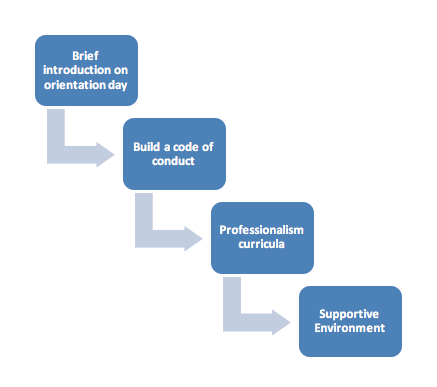
According to my best educated guess, some of the teaching methods which can help in teaching culturally sensitive issues are discussed as follows.
Brief introduction on orientation day:
During the white coat ceremony for first year, a formal address from the Dean, Principal or any other notable medical figure on culture, ethics and professionalism can be incorporated. This can help in establishing expectations and boundaries for acceptable behaviors in medical students throughout their journey. (Birden et al., 2013)
Build a code of conduct:
To teach cultural sensitivity and professionalism, a code of conduct must be built relevant to the societal needs, not downloaded. At the beginning of each academic year, the document should be revised and updated before distributing to faculty and students.
Professionalism curricula:
Whether a medical institute is following the traditional or the integrated curriculum, culturally sensitive issues can be taught through various methods. Some of the feasible methods are as follows:

Fig 2: Teaching methods for professionalism.
Didactic lectures are an efficient method to teach cognitive base of professionalism to a large number of students. To make lectures more interactive, videos showing clinical scenarios followed by discussion from students can facilitate learning.(Steinert, Snell, Steinert, & Snell, 2015)
Example 1:
When teaching infectious diseases, we can show documentaries on patients of HIV, hepatitis or tuberculosis and their daily hardships.
Example 2:
In reproductive system, social issues regarding contraception, infertility, pregnancy in unmarried girls can be discussed.
Small group discussions e.g. PBL, CBL, tutorials and lab practical can be made very effective.
Example 1:
In PBL, taboos of addiction can be discussed.
Example 2:
In CBL, examination of female patient and cultural issues regarding privacy and exposure can be critically analyzed.
Example 3:
While doing lab work, communication skills and professional attitude towards paramedics and helping staff can be taught to students.
Role Modelling:
Students learn a lot from role models who have clinical competence, excellent teaching skills and desirable personal qualities.(Passi, Doug, Peile, Thistlethwaite, & Johnson, 2010)
Example 1:
In OPD or clinics, how medical teachers interact with patients from low socioeconomic status, including their queries related to their medical condition, is considered an excellent approach.
Example 2:
In clinical clerkship, students watch and learn the professional attitude of their teachers, when offered gifts or foreign trips by pharmaceutical companies.
Role play:
In role play, we can give students a scenario and ask two or three of them to act, while the remaining class can observe and later discuss among themselves.
Example 1:
Speaking up against an impaired colleague or reporting a medical negligence by a senior are some of the culturally sensitive issues, which can be recognized through role play.
Reflective Writing:
After interacting with patients, we can ask our students to reflect on their experience and write down what went well and what could have been done better.(Aronson, 2011)
Example 1:
A conflict occurs between a surgeon and a patient’s husband regarding consent for hysterectomy.
Example 2:
Delivering sad and unexpected news to the patient and family.
Environment of Institute:
Finally, to achieve our goals we need to seek institutional support. The environment of the institute must be ready for change in policies. The hidden curriculum (that influences structure, function and culture of an institute) must be in harmony with the formal curriculum.(Yelon, Ford, & Anderson, 2014)
Fig 3: Steps for teaching culturally sensitive issues
Limitations:
In my humble opinion, teaching culturally sensitive issues is a domain beyond the scope of this assignment due to the following limitations:
- Culture of our region is changing constantly.
- Designing methods for teaching sensitive issues is easy but implementing them is very difficult.
- Assessment of students regarding learning and attitude is a time consuming process and can be only assessed during real clinical situations.
Despite the limitations, an initiative has to be taken, to make our graduates professional and community oriented.
References
Abdel-Razig, S., Ibrahim, H., Alameri, H., Hamdy, H., Haleeqa, K. A., Qayed, K. I., … Falahi, S. Z. Al. (2016). Creating a Framework for Medical Professionalism: An Initial Consensus Statement From an Arab Nation. Journal of Graduate Medical Education, 8(2), 165–172. https://doi.org/10.4300/JGME-D-15-00310.1
Al-Eraky, M. M., Donkers, J., Wajid, G., & Van Merrienboer, J. J. G. (2015). Faculty development for learning and teaching of medical professionalism. Medical Teacher, 37 Suppl 1(November), S40-6. https://doi.org/10.3109/0142159X.2015.1006604
Aronson, L. (2011). Twelve tips for teaching reflection at all levels of medical education. Medical Teacher, 33(3), 200–205. https://doi.org/10.3109/0142159X.2010.507714
Birden, H., Glass, N., Wilson, I., Harrison, M., Usherwood, T., & Nass, D. (2013). Teaching professionalism in medical education: a Best Evidence Medical Education (BEME) systematic review. BEME Guide No. 25. Medical Teacher, 35(7), e1252-66. https://doi.org/10.3109/0142159X.2013.789132
Cruess, S. R., Johnston, S., & Cruess, R. L. (2002). Professionalism for medicine: Opportunities and obligations. Medical Journal of Australia, 177(4), 208–211.
Ho, M., & Al-Eraky, M. (2016). Professionalism in Context: Insights From the United Arab Emirates and Beyond. Graduate Medical Education, 8(2), 268–270. https://doi.org/10.4300/JGME-D-16-00103.1
Humayun, A., Fatima, N., Naqqash, S., Hussain, S., Rasheed, A., Imtiaz, H., & Imam, S. Z. (2008). Patients’ perception and actual practice of informed consent, privacy and confidentiality in general medical outpatient departments of two tertiary care hospitals of Lahore. BMC Medical Ethics, 9, 14. https://doi.org/10.1186/1472-6939-9-14
Ludwig, S., & Day, S. (2011). New Standards for Resident Professionalism: Discussion and Justification. In Ehancing Quality of Care, Supervision, and Resident Professional Development (pp. 47–51). Retrieved from https://www.acgme.org/Portals/0/PDFs/jgme-11-00-47-51%5B1%5D.pdf
Passi, V., Doug, M., Peile, E., Thistlethwaite, J., & Johnson, N. (2010). Developing medical professionalism in future doctors: a systematic review. International Journal of Medical Education, 1, 19–29. https://doi.org/10.5116/ijme.4bda.ca2a
Steinert, Y., Snell, L. S., Steinert, Y., & Snell, L. S. (2015). Interactive lecturing : strategies for increasing participation in large group presentations Interactive lecturing : strategies for increasing participation in large group presentations, 21(November). https://doi.org/10.1080/01421599980011
Yelon, S. L., Ford, J. K., & Anderson, W. a. (2014). Twelve tips for increasing transfer of training from faculty development programs. Medical Teacher, (November), 1–6. https://doi.org/10.3109/0142159X.2014.929098

