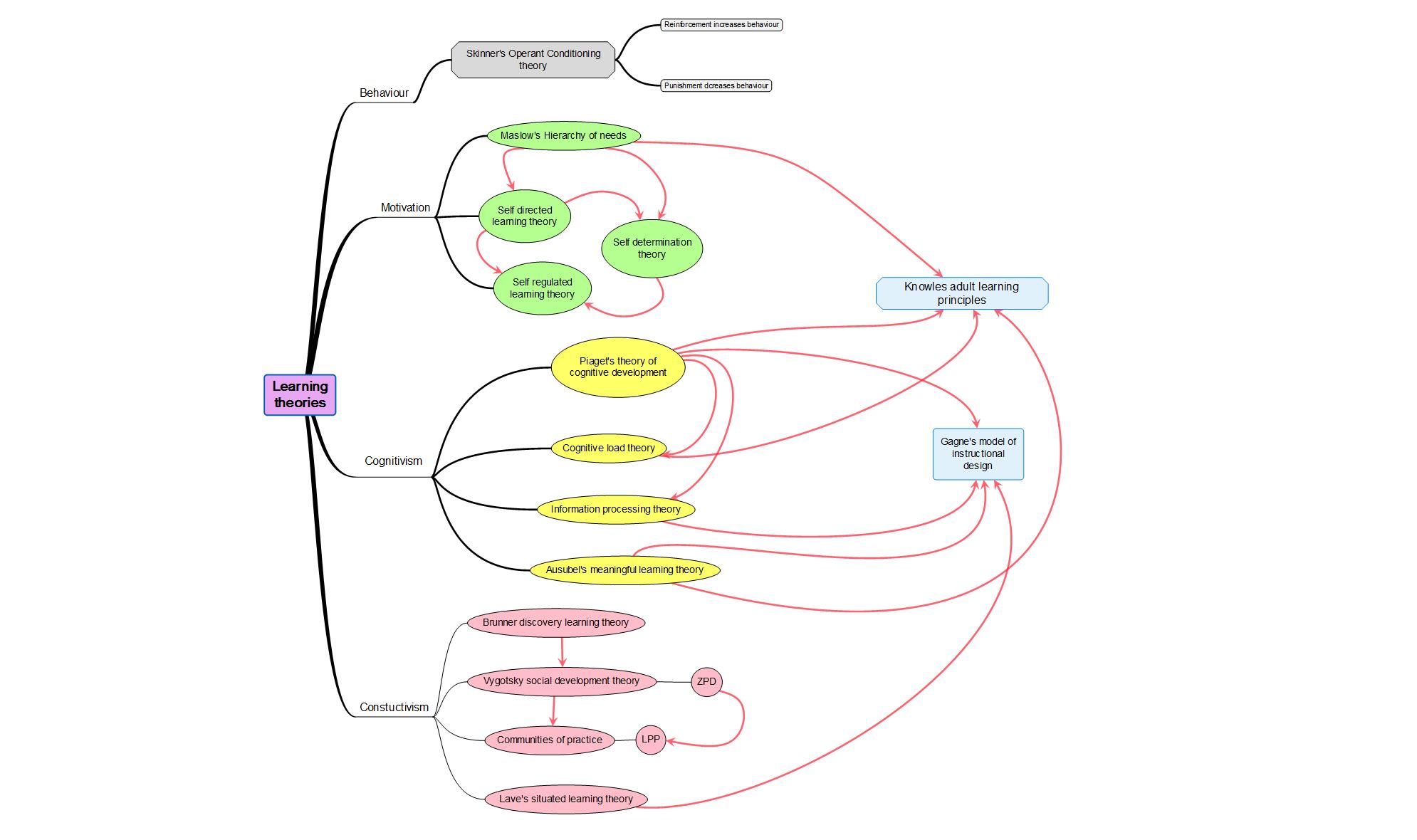
| Theory | Basis | Application |
| Skinner’s Operant conditioning | This theory comes under the paradigms of behavior and its based on the idea that behaviors that are reinforced will continue, but behaviors that are followed by punishment will end. This theory proposed the concept of operant conditioning, which makes an attempt to change behavior by using positive and negative reinforcement; therefore, a person makes a link between a specific behavior and its consequence. | To apply this theory in medical education, one way is to get a computerized system that combines tutorial programs with programs that monitor student performance and provide feedback to both student and teacher. A facilitator awards points to those students who took part actively so that students are encouraged to contribute more and their learning is improved.(Malala, Major, Maunez-Cuadra, & McCauley-Bell, 2007) |
| Piaget’s theory of Cognitive development | This theory is based on studying the cognitive development of children and adolescents, in which Piaget identified four major stages sensorimotor, preoperational, concrete operational and formal operational. Piaget believed all children pass through these stages to advance to the next level of cognitive development. In each stage, children show new intellectual abilities and complex understanding of the world and may exhibit behaviors characteristic of more than one stage. (Strauss, 2000) | An important application of Piaget’s theory is modifying the instructions according to the developmental level of learner. Use familiar examples to facilitate learning more complex ideas, such as story problems in clinical cases. We as facilitators can classify and group information with increasing complexity. We can also use outlines and hierarchies to assimilate new information with previous knowledge. This is significant in terms of developing instruction for medical students who are adults, but may be limited in their understanding of abstract concepts. |
| Vygotsky social development theory | According to his theory life long process of development is dependent on social interaction. This phenomena is known as the Zone of Proximal Development (ZPD) which bridges the gap between what is known and what can be known. Vygotsky claimed that learning occurred in this zone. (Costley, 2012) | In applying this theory a teacher should change his role from dictator to facilitator. The seating arrangement of class should be made in such manner that students sit in form of groups instead of audience. These groups should be selected in a way that each group should have a variety of students from low scorer to high achiever. The instructional design of material to be learned should be able to promote and encourage student interaction and collaboration. Thus the classroom becomes a community of learning. In other words, a student can perform a task under adult guidance or with peer collaboration that could not be achieved alone. |
| Self-Directed learning theory | Self-Directed learning is an informal process that primarily takes place outside the classroom. The learner makes decisions about content, methods, resources, and evaluation of the learning. Individuals take responsibility for their own learning process by determining their needs, setting goals, identifying resources, implementing a plan to meet their goals, and evaluating the outcomes.(Hiemstra & Brockett, 2012) | In order to make a student self-directed learner, the teacher should design an interactive lecture. First distribute a note taking guide which would contain key points, space for written notes, and two key multiple choice or “short answer” questions requiring higher level thinking, then stop twice during the lecture and ask the students to discuss their response to each question with their neighbors. A show of hands would determine the class responses to the question (checking for understanding) and you could then give the correct answer. Finally, assign a learning issue for the students to research in their own time. |
| Self-Determination Theory | Self-determination theory is a macro theory of human motivation and personality concerned with supporting natural or intrinsic tendencies to identify and achieve goals.(Joo, Lim, Han, Ham, & Kang, 2013) | To achieve the goals of self-regulation theory, students must be prepared to participate in planning for their future. The role of a facilitator in making his students self-directed learner cannot be ignored. Facilitator should design course curriculum with instructions in a way, which can help students achieve their long-term goals. Instructions should be provided to make students aware of their strengths and weaknesses, their needs and wants, communication skills and confidence to make their own decisions. |
| Self-Regulation theory | This theory is based on the ability of a learner to understand and control his learning environment. It is a self directive process and set of behaviours where learners transform their mental abilities into skills and habits through a development process that emerges from guided practice and feedback.(Zumbrunn, Tadlock, & Roberts, 2011) | In order to transform students into self regulated learners a facilitator should guide him to set short term goals, which allow them to take their progress to long term goals. Keeping the goal in mind learners considers time, strategies and resources they would need to get there. It is extremely important for the facilitator to keep in mind the developmental level of learners. Self regulated learners must clear their minds, pick the right tools for learning, know when to ask for help and should be able to monitor their performance through reflection. |
| Cognitive load theory | Cognitive load theory assumes that the human cognitive system has a limited working memory that can hold no more than five to nine information elements and actively process no more than two to four elements simultaneously. It is able to deal with information for no more than a few seconds and almost all information is lost after about 20 seconds unless it is refreshed by rehearsal.(Bandura, 1986). | In medical teaching we can make our lectures interesting and decrease the cognitive load for students by explaining with pictures, mini and power point instead of texts. We can also show animations for complex processes or cycles. This proved to be the case when a condition with animation plus narration proved more effective than narration alone. Schemas can also reduce working memory load and aids the storage and organization of information in long-term memory and reduces working memory load. Another method to reduce cognitive load is with the help of concept maps.(Jiang & Perkins, 2013) |
| Knowles adult learning principles | It is based on characteristics of adults and their specific learning requirements. Adults are self- directed, motivated, goal-oriented, experienced and learn by doing.(Baskas, 2011) | Students should be made aware of the traits of adult learners by the facilitator and different activities should be designed to gain main characteristics of adult learners. The facilitator should set a goal and convert theoretical learning to practical activities through giving students freedom to achieve this goal by applying their previous knowledge into new one and motivate them with relevance to real life problems. The activities they are engaged must directly contribute to achieve learning objectives. Once the learning objective is achieved their contribution should be acknowledged so in future they put in more effort and become more productive. |
| Maslow’s Hierarchy of needs | Maslow’s hierarchy of needs is a motivational theory and represented by a pyramid with five levels. The lowest four levels comprising of physiological needs, safety, belongingness and esteem are considered deficiency or deprivation needs and abbreviated, as D needs. When D needs are obtained, the highest level, which is self-actualization, is attained and it is driven by one’s desire for personal growth and need to become all the things he is capable of.(Francis & Kritsonis, 2006) | The teacher must know the physiological needs of students e.g. lunch and water break. Class room temperature should be good and a student should be allowed to go to restrooms. Next safety level should be achieved through accepting, fair and non-judgemental attitude from the teacher. To achieve the next level of belonging teacher should be approachable and create a learning environment in class through peer learning and group activities. To acquire self-esteem we should involve all students in class participation and responsibilities. To achieve self-actualization plan lessons those connect areas of learning and give students freedom to explore on their own. |
| Gagne’s instructional design | Gagne’s model of instructional design is based on the information-processing model of the mental events that occur when adults are presented with various stimuli and focuses on the learning outcomes and how to arrange specific instructional events to achieve those outcomes. Gagne’s events of instruction consist of the following. Gaining attentionInforming the learner of the objectiveStimulating recall of prerequisite learningPresenting the stimulus materialProviding learning guidanceEliciting the performanceProviding feedbackAssessing the performanceEnhancing retention and transfer.(Martin, Klein, & Sullivan, 2004) | In medical teaching we can capture attention of the students by providing an interesting picture regarding the topic or by stimulating learners curiosity with questions. Next we provide them all the learning objectives so they can get an overview of the topic. By associating new information with previous knowledge and personal experience and getting the learners to think about what they already know can facilitate the learning process e.g. by asking them to make concept maps. In lecture present information in a way, which is, clear, up-to-date and interesting to the audience. The information provided must have links and resources. Students should be assigned meaningful tasks with clear instructions. When students are performing the tasks, encouragement and feedback should be given. Allow students to reflect on their own learning. To enhance retention study groups should be assigned and students should coach and scaffold others. |
| Situativity theory | It is based on the concept that students are more likely to learn by actively participating in their learning as opposed to listening to lectures. Situated learning means to have a thought and action which is used at right time and place. In this approach the content is learnt through doing activities. The situated model of learning is part of Lave and Wengers’s theory of communities of practice that states that learning should not be viewed as mere transmission of knowledge but as a distinctly embedded and active process.(Owen, 2006) | We can apply this theory in medical teaching with problem solving programs (simulations) i.e. we can teach our students new information and skills and provide an opportunity to apply what was learned in a meaningful way. In this way students will be able to perform clinical skills that are not routinely practiced because of cost, physical danger, and time limitations. |
| Ausubel’s meaningful learning | Ausubel believes that learning of new knowledge depends on what we already know. It states that construction of knowledge starts with our observation and recognition of events and objects through concepts we already have. We learn by constructing a network of concepts and adding to them. (Kean & Kwe, 2014). Ausubel believed that understanding concepts, principles, and ideas are achieved through meaningful learning. Because meaningful learning involves recognition of the links between concepts, it has the privilege of being transferred to long-term memory. The most crucial element in meaningful learning is how the new information is integrated into the old knowledge to the extent that it can be related to what is already known.(Stalheim-Smith, 1998) | We can apply this theory in our lectures by first asking the students to make concept map of the topic to be taught. In this way teacher can assess the prior knowledge of students regarding subject and also can identify the misconceptions among the students.(Novak, 2011) |
| Brunner discovery learning | According to this theory students construct their own new knowledge by organizing and categorizing information using a coding system. Bruner’s theory is a combination of content and strategies in which students discover their own coding system instead of being taught by the teacher. (Arifani, 2016). According to Brunner, personal experience and social interaction of a learner plays an important role in discovery learning.(Learning, 2000) | In medical settings, the role of the teacher should not be to teach information by rote learning, but instead to facilitate the learning process. This means that a good teacher will design lessons that help students discover the relationship between bits of information. To do this a teacher must give students the information they need, but without organizing for them. A teacher can also give his students a learning environment, an instructional guideline and ask them to explore a pre-determined problem. In this way students can construct new knowledge on their previous knowledge and solve a problem by discovering new information.(Castronova, 2002) |
| Theory of communities of practice | This theory is based on the notion that when a group of people who have common passion or interest in a subject or area integrate with each other, by sharing ideas and strategies, to solve problems over a period of time, they become a community. (Teeter et al., 2011) | A facilitator can transform his classroom into a community of practice by designing a course that promotes learning through social interaction. Students are encouraged to form and work in groups, complete their assignments through a team effort, and interact with their peers’ through social media by posting their learning and experiences. |
| Atkinson-Shiffrin theory of information processing | This is based on the fact that human memory could be broken into three different memory stores. Sensory memory takes in a lot of information through our senses, but majority of it cannot be processed due to limitations of our memory system and is lost within two seconds. The rest of the sensory memory enters the short term memory which is retainable up to eighteen seconds and can be converted into long term memory which is permanent through rehearsal.(Moore, Williams, North, Johri, & Paretti, 2015) | To apply this memory model into teaching a facilitator should design his lecture in a way that can grab student attention till the end and his working memory can process information to the maximum potential. This can be achieved by adding metaphors, which can be either visuals or verbal information. The lecture slides should be minimum with emphasis on the relevant topic. During lecture by sharing a real life experience or a joke can help students to relate to the information later. |
Reference
Arifani, Y. (2016). The Implementation of Team-Based Discovery Learning to Improve Students’ Ability in Writing Research Proposal. International Education Studies, 9(2), 111–119.
Bandura, A. (1986). Social Cognitive Theory Of Learning. Social Foundations of Thought and Action, 1–7.
Baskas, R. S. (2011). Applying Adult Learning and Development Theories to Educational Practice. Online Submission.
Castronova, J. (2002). Discovery learning for the 21st century: What is it and how does it compare to traditional learning in effectiveness in the 21st century. Action Research Exchange, 1(1), 1–12.
Costley, K. C. (2012). An Overview of the Life, Central Concepts, Including Classroom Applications of Lev Vygotsky. Online Submission.
Francis, N. H., & Kritsonis, W. A. (2006). A Brief Analysis of Abraham Maslow’s Original Writing of. Online Submission, 3(1).
Hiemstra, R., & Brockett, R. G. (2012). Reframing the Meaning of Self-Directed Learning: An Updated Model. In Proceedings of the 54th Annual Adult Education Research Conference (pp. 155–161).
Jiang, X., & Perkins, K. (2013). A Conceptual Paper on the Application of the Picture Word Inductive Model Using Bruner’s Constructivist View of Learning and the Cognitive Load Theory. Interdisciplinary Journal of Teaching and Learning, 3(1), 8–17.
Joo, Y. J., Lim, K. Y., Han, S. Y., Ham, Y. K., & Kang, A. (2013). The Effects of Self-Determination on Learning Outcomes in a Blended Learning. International Association for Development of the Information Society.
Kean, A. C., & Kwe, N. M. (2014). Meaningful Learning in the Teaching of Culture: The Project Based Learning Approach. Journal of Education and Training Studies, 2(2), 189–197.
Learning, D. (2000). Jerome S. Bruner: Discovery Learning, 4173.
Malala, J., Major, A., Maunez-Cuadra, J., & McCauley-Bell, P. (2007). The Use of Rewards in Instructional Digital Games: An Application of Positive Reinforcement. Online Submission.
Martin, F., Klein, J., & Sullivan, H. (2004). Effects of Instructional Events in Computer-Based Instruction. Association for Educational Communications and Technology.
Moore, J., Williams, C. B., North, C., Johri, A., & Paretti, M. (2015). Effectiveness of Adaptive Concept Maps for Promoting Conceptual Understanding: Findings from a Design-Based Case Study of a Learner-Centered Tool. Advances in Engineering Education, 4(4).
Novak, J. D. (2011). A theory of education: Meaningful Learning Review, 1(2), 1–14.
Owen, S. (2006). Situated Researcher Reflections and Professional Learning Journeys. Australian Journal of Adult Learning, 46(1), 114–118.
Stalheim-Smith, A. (1998). Focusing on active meaningful learning.pdf. Idea Center, Kansas Sate University.
Strauss, S. (2000). Theories of Cognitive Development and Learning and Their Implications for Curriculum Development and Teaching.
Teeter, C., Fenton, N., Nicholson, K., Flynn, T., Kim, J., McKay, M., … Vajoczki, S. (2011). Using Communities of Practice to Foster Faculty Development in Higher Education. Collected Essays on Learning and Teaching, 4, 52–57.
Zumbrunn, S., Tadlock, J., & Roberts, E. D. (2011). Encouraging Self-Regulated Learning in the Classroom : A Review of the Literature, (October).

